Topics

AI & Search Marketing: What Actually Matters For Your Business
on
Last updated on
This content has been adapted from a Concise Digital webinar presented by Gareth Lane (Founding Director) and Andy McWhirter (AI SEO Specialist). Learn about the impact of artificial intelligence as it disrupts traditional online search, the increased importance of brand trust and credibility in the world of AI SEO, and how businesses can start optimising for AI overviews and chatbots like ChatGPT and Gemini today.
The Evolution of Search Behaviour
For over two decades, Google has held a 95% monopoly on search, with traditional SEO marketing strategies revolving almost entirely around keywords, on-page SEO and off-page SEO. However, we are now entering a new era of search where context, meaning, and brand trust are becoming new primary drivers of online visibility, particularly when it comes to popular AI chatbots such as Gemini and ChatGPT.
While traditional Google search is still growing – reaching 5 trillion searches annually (representing a trillion searches in growth over the last year) – there is a clear shift in how users are searching for information – which is fundamentally changing how users are find and choosing businesses online.
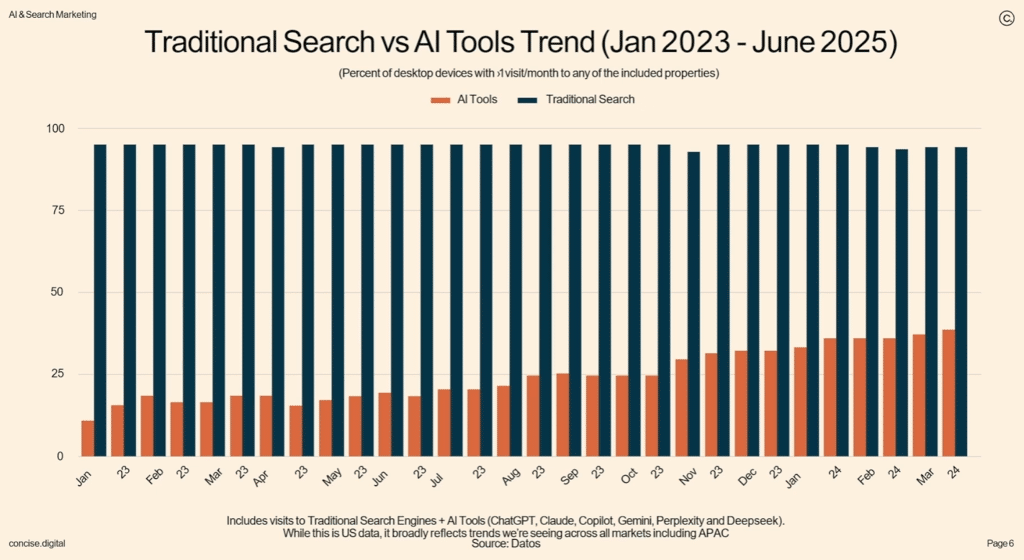
The shift toward AI is driven by convenience. Instead of the traditional method of a user clicking on through three or four websites, reading various articles, and manually synthesising an answer, AI can provides a comprehensive, concise summary at a fraction of the time. This has led to the rise of “zero-click searches”, where users satisfy their informational needs without ever visiting a website.
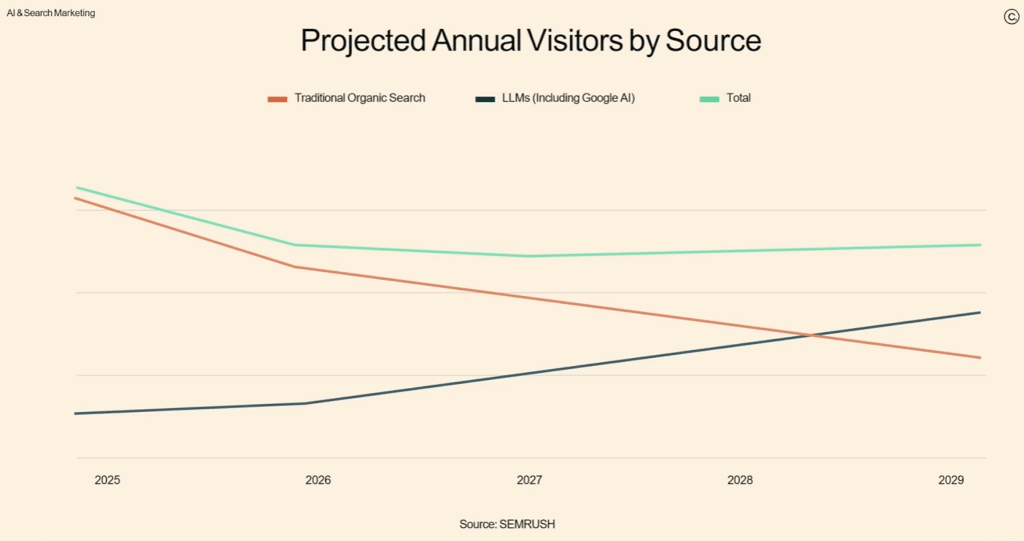
While traditional search marketing remains effective for targeting the bottom of the sales funnel, businesses must now adapt to an environment where AI tools like ChatGPT and Gemini are increasingly used for research and brand selection. Desktop usage of AI tools is trending “up and to the right”, and projections suggest that by late 2028, traffic from AI chatbots such as Gemini, ChatGPt and Perplexity could overtake traditional organic search in volume.
What is AI SEO?
AI SEO (often referred to as AI Search Optimisation) is an umbrella term encompassing Answer Engine Optimisation (AEO) and Generative Engine Optimisation (GEO). It is not a replacement for traditional SEO, but rather an evolution that builds upon it. To be recommended by AI, a business must still be indexed and ranking in high positions on traditional search engines like Google or Bing, which is why traditional SEO is the core foundational layer of AI SEO.
The fundamental difference lies in how AI processes queries. Through a process called a “query fan out“, AI chatbots takes a complex, contextual prompt, runs multiple background searches, and parses the data to provide a unified response.
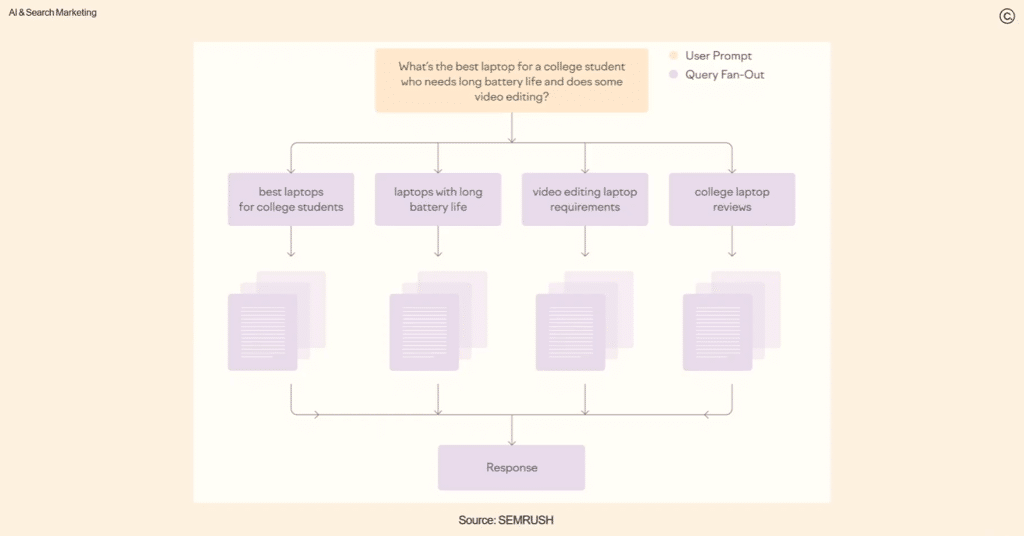
Consider this example: “What is the best laptop for a college student who needs a long battery life and does some video editing?”. Unlike a traditional search engine that might just look for those specific keywords, an AI like ChatGPT or Gemini performs a “query fan out”.
It runs multiple background searches on the specific requirements (video editing capabilities, battery life ratings), parses that data, and synthesises it into a unified response. Users can even prompt the chatbot to reveal which “query fan” it used to see exactly how it arrived at its recommendations.
The Trust Factor: How AI Chooses Your Business
A critical component of AI SEO often overlooked is the trust analysis that occurs once a user demonstrates transactional intent. The AI chatbot analyses the top businesses for credibility using several layers of data. This includes:
- First-party data: The internal content and technical structure of your own website.
- Third-party mentions: Mentions on platforms like Reddit, YouTube, LinkedIn, and industry-specific sites. AI chatbots favours brands that appear established and capable across the wider web. Mentions in the world of AI SEO are now the functional equivalent of a traditional SEO backlink.
A helpful analogy: It is similar to asking for a recommendation at a barbeque. Your mate (i.e. your website) is your first point of reference, but then AI wants to go a step further and ‘ask their mates’ (i.e. the wider internet) to validate what your mate said. This multi-level trust is why a positive mention on a third-party site is now as powerful as a backlink, even without the need for a clickable link pointing back to your site.
What’s the Difference: AI Overviews vs. AI Chatbots
AI Overviews (Google Search)
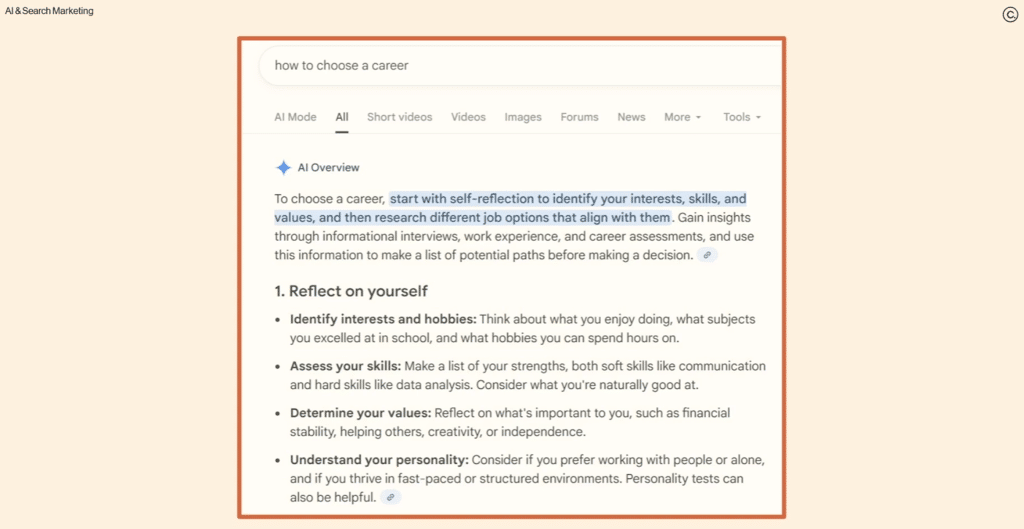
We have found that Google’s AI overviews (formerly known as SGE) have generally provoked two concerns for businesses:
- How does my business appear in the AI overviews?
- How do we mitigate zero-click searches?
Currently, 75% of the links cited in these overviews come from page one of Google’s organic results, making them essentially a summary of the top listings. Strong SEO and AI SEO (including well structed content) often leads strong AI overview citations.
AI overviews primarily serve informational intent – answering who, what, where, why, and how questions. To break it down, 84% of the time an AI overview appears it is informational intent, and 3% is navigational intent, meaning that 87% of the time it appears it is for a question. Only 12% of appearances are for commercial intent, and 1% for transactional intent.
The challenge with AI overviews this “zero-click search” phenomenon. Since the AI overview provides the answer directly in the search results, the data is showing only 1% of users are actually clicking on a link within the overview. While good for brand awareness, Google’s AI overviews currently should only be a secondary focus for an AI SEO strategy.
AI Chatbots (AI SEO)

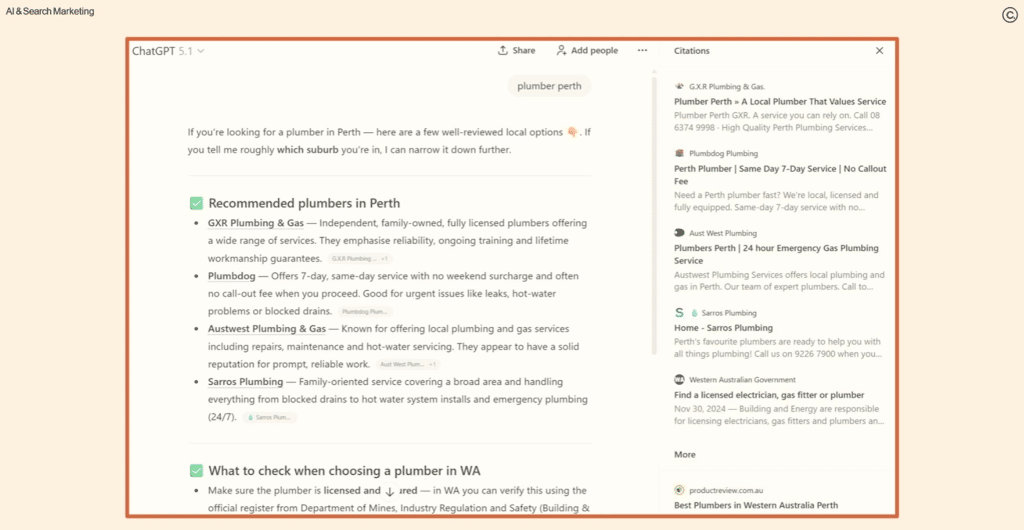
The difference with AI chatbots is that they will always provide an answer 100% of the time regardless of the user’s intent. While an AI overview might not appear under a transactional search like “plumber perth”, an AI chatbot will always provide a direct recommendation.
Key Strategies for AI Optimisation
To stay ahead, businesses must focus on both on-page and off-page AI SEO signals:
1. On-Page: Topical Depth and Structure
- Topical Authority: Rather than targeting broad terms like “dentist perth,” businesses should build out deep content categories such as “emergency dental care perth” or “gum disease treatment perth” to demonstrate specialised expertise.
- Structured Content: AI prefers logical page structures with clear headings, FAQs, and schema.
- Evidence-Backed Claims: Move away from generic statements. Use strong language that sells, such as: “We’ve helped 10,000 customers achieve a 10% conversion rate over the last 5 years”.
- Trust Pages: AI looks deeper than just an About Us or Contact page. Establishing pages for Careers, Investors, and Media/Press enquiries signals that you are a large, trustworthy, and established brand.
- Real Proof: Back up all claims by linking to Testimonials, Reviews, Case Studies, and Awards to provide the AI with verifiable data.
2. Off-Page: Brand Reputation and Sentiment
- External Presence: Mentions on third-party sites such as Reddit, YouTube, LinkedIn and industry sites. Press releases, listicles, and comparison articles are good signals. AI prefers brands that appear active, credible and talked about online.
- Reviews & Sentiment: The quantity and quality of a business’s reviews and/or third-party directory listings are taken into account by AI SEO chatbots. AI chatbots often analyse the sentiment of reviews. A review that says “they issued a refund immediately” or “they arrived early” provides much more context for an AI than a simple five-star rating.
- Reverse Engineering Mentions: By identifying which sources the AI cites when recommending competitors, businesses can work to gain placements on those same industry platforms.
Measuring Success in the AI Era
Unlike traditional SEO, there is currently no public “prompt volume” data available from AI tools like ChatGPT or Gemini. To measure success, we recommend:
- Google Analytics 4 (GA4): Tracking real traffic coming from AI channels.
- Brand Tracking Tools: Using platforms like Peec.AI to monitor your brand’s average position for specific AI prompts and tracking mentions over time.
Next Steps For Your Business
The disruption to the online search status quo has already begun. To ensure AI chatbots mention your business you must transition toward a strategy that prioritises context and trust. Concise Digital has developed a dedicated AI SEO service to help businesses audit their current AI SEO standing and implement a tailored strategy for this new era.
Ready to find out how AI SEO can help your business? Book a one-on-one session with our team to discuss your AI SEO strategy today!